

Nothing in Muay Thai carries the same reputation as the elbow strike. It's the technique new students ask about most, watch highlight reels of, and — more often than not — are quietly nervous to actually throw for the first time. Here's what elbows are really about, and why the fear usually says more about misunderstanding the technique than the technique itself.
What Elbow Strikes Are Actually Used For
Elbows are a close-range weapon. They come into play when distance closes — in the clinch, during an exchange, or when an opponent steps in tighter than a kick or a straight punch can handle. Because the elbow is a hard, compact striking surface with very little cushioning behind it, it's capable of opening cuts and ending exchanges quickly, which is exactly why it has the reputation it does.
But reputation aside, elbows aren't a power technique in the way a kick or a hook is. They're a precision technique. A well-thrown elbow doesn't rely on brute force — it relies on tight mechanics, correct angle, and timing. In competition, you'll often see elbows used less frequently than kicks or knees, but when they land clean, they tend to be decisive. That's the paradox worth understanding early: elbows are dangerous specifically because they're technical, not because they're wild.
There are several core elbow strikes in the Muay Thai arsenal — horizontal elbows that travel across the body, upward elbows (sok ngat) that drive through an opponent's guard from below, downward elbows used when an opponent is bent forward, and spinning elbows that generate momentum through rotation. Each has a different use case depending on range, angle, and what your opponent is giving you.
Common Mistakes Beginners Make With Elbows
The most common mistake by far is telegraphing. Elbows are a short-range technique, which means there's very little time between "the strike is coming" and "the strike has landed" if it's thrown correctly. Beginners often wind up before throwing an elbow — dropping the shoulder, pulling the arm back — which gives the technique away and defeats the entire point of using a close-range strike in the first place.
The second common mistake is relying on arm strength instead of hip and shoulder rotation. A powerful elbow doesn't come from the arm swinging harder. It comes from the same rotational mechanics that power a hook or a roundhouse kick — hips turning, shoulder driving through the target, the arm essentially just transmitting force that's generated somewhere else. Students who try to muscle an elbow through with the arm alone tend to lose both power and accuracy.
Distance management is the third major issue. Elbows only work at very close range. Beginners frequently throw them from too far away, missing the target entirely or making contact with the forearm instead of the point of the elbow, which reduces effectiveness significantly. Learning to close distance safely — often through a jab, a clinch entry, or forward pressure — is just as important as the strike itself.
Finally, a lot of beginners forget defense the moment they throw an elbow. Because the technique feels aggressive, there's a tendency to commit fully and forget to reset guard immediately afterward. Good elbow technique always includes the return — hand back up, chin protected, ready for a counter.
Step-by-Step: How the Core Elbows Work
Horizontal Elbow
Start in your stance with hands up. Rotate your hips and shoulders together, driving the elbow across your body in a tight, compact arc — think of your arm folding rather than swinging. The strike should land with the point of the elbow, not the forearm. Reset your guard the instant contact is made.
Upward Elbow (Sok Ngat)
This strike travels from low to high, typically used to split an opponent's guard or catch them as they duck or move forward. Bend your knees slightly to drop your base, then drive upward through your legs and hips, letting the elbow travel vertically. Power comes from the leg drive as much as the arm.
Downward Elbow
Used when an opponent is bent at the waist — often after a clinch break or a takedown attempt. The elbow drives downward and slightly forward, using gravity and shoulder rotation together. Timing matters more than raw strength here.
Spinning Elbow
The most advanced of the four, and the one that requires the most caution while training. It uses full-body rotation to generate momentum, but it also briefly takes your eyes off your opponent, which makes it a lower-percentage technique unless timed well. This one should only be trained once the fundamentals of the other three are genuinely solid — not sooner.
Why Elbows Change the Way You Think About Range
Learning elbows properly does something beyond adding a new weapon to your game — it changes how you think about distance in general. Most beginners approach Muay Thai thinking in terms of "far range" for kicks and "mid range" for punches, without much awareness of what happens once distance closes all the way down. Elbows force you to get comfortable in that uncomfortable close range, where a lot of fighters instinctively want to back away.
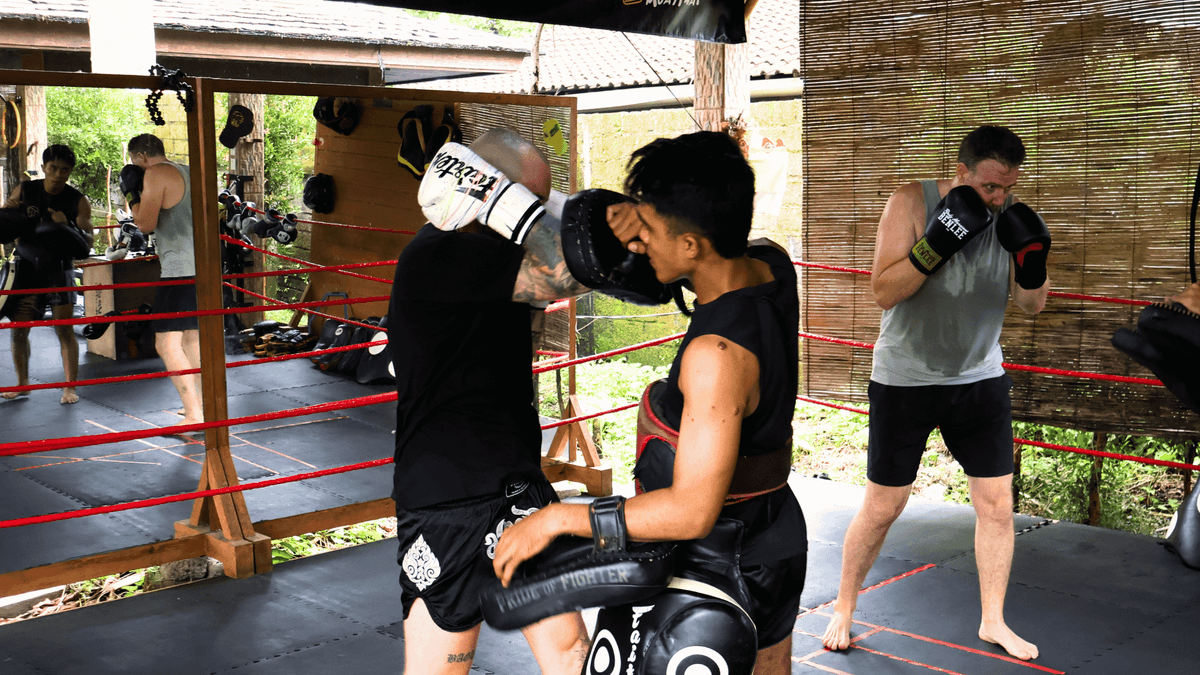
Once you've trained elbows for a while, you start noticing opportunities you'd have missed before — a slight step in from an opponent, a moment where their guard drops as they throw a kick, a clinch that breaks at exactly the wrong angle for them and the right one for you. None of that is really about the elbow itself. It's about range awareness, which elbows are one of the best tools for developing precisely because they only work when everything else — distance, timing, angle — is already correct.
This is also part of why elbows tend to be one of the more satisfying techniques to develop as a student progresses past the beginner stage. Early on, most of the sport is about big, gross movements: kicks, punches, footwork. Elbows are where things start to get genuinely technical, and where the sport starts rewarding precision over power in a way that's very different from how most people initially picture Muay Thai.
Training Elbows Without Injury
Because elbows are unforgiving if thrown carelessly, injury prevention is worth addressing directly rather than assuming it'll sort itself out. The two most common injury points are the elbow joint itself — from repeated hard-surface contact on pads or bags without proper conditioning — and the training partner on the receiving end, if control isn't there yet.
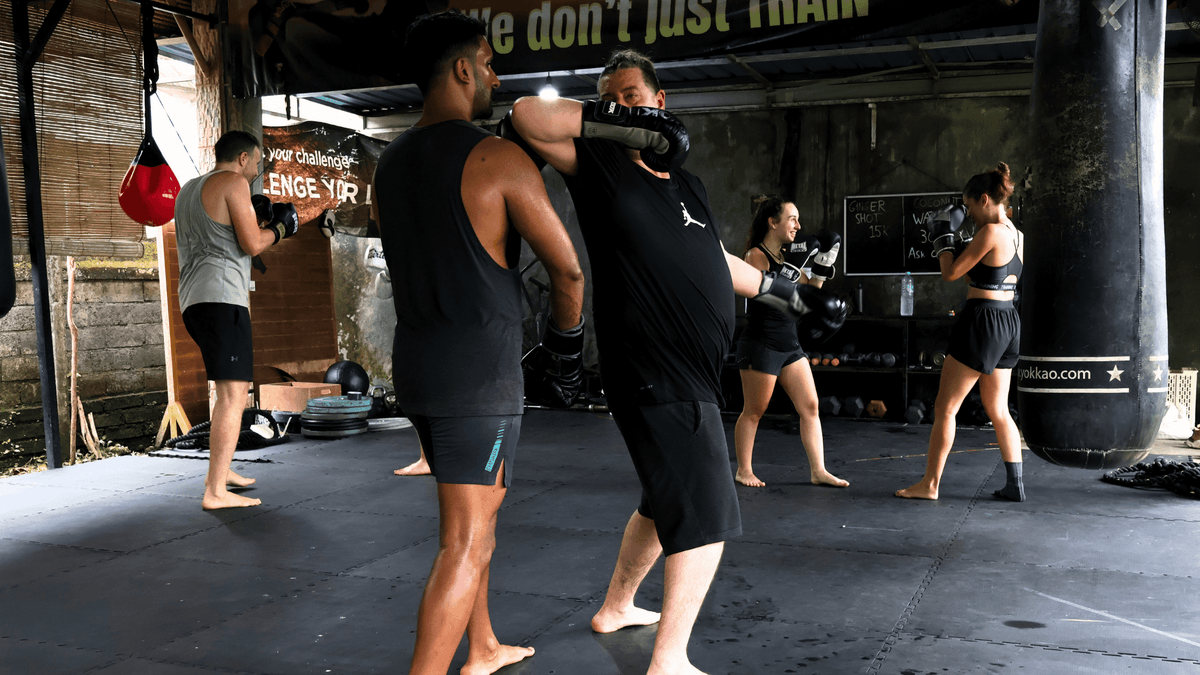
Conditioning the elbow gradually, the same way you'd condition shins for kicking, matters more than most beginners expect. Starting with lighter pad work and progressively increasing intensity gives the joint and surrounding tissue time to adapt, rather than jumping straight into full-power drilling. Wrapping and appropriate padding during partner drills isn't optional at this stage either — it's what allows control to be trained safely in the first place.
The instinct to rush toward "advanced" technique is understandable, especially with something as visually striking as a spinning elbow. But the fighters who use elbows well, competitively or otherwise, are almost always the ones who spent real time on fundamentals before layering in complexity. That patience is exactly what separates a technique that looks impressive from one that's actually reliable under pressure.
How Our Trainers Teach Elbow Safety and Control
Because elbows are one of the higher-risk techniques in Muay Thai, they're not something we throw new students into without structure. At Ubud Muay Thai, elbow technique is introduced progressively — shadow drilling the mechanics first, moving to pad work with a coach who can control range and pace, and only later working elbows in controlled partner drills with appropriate protective gear.
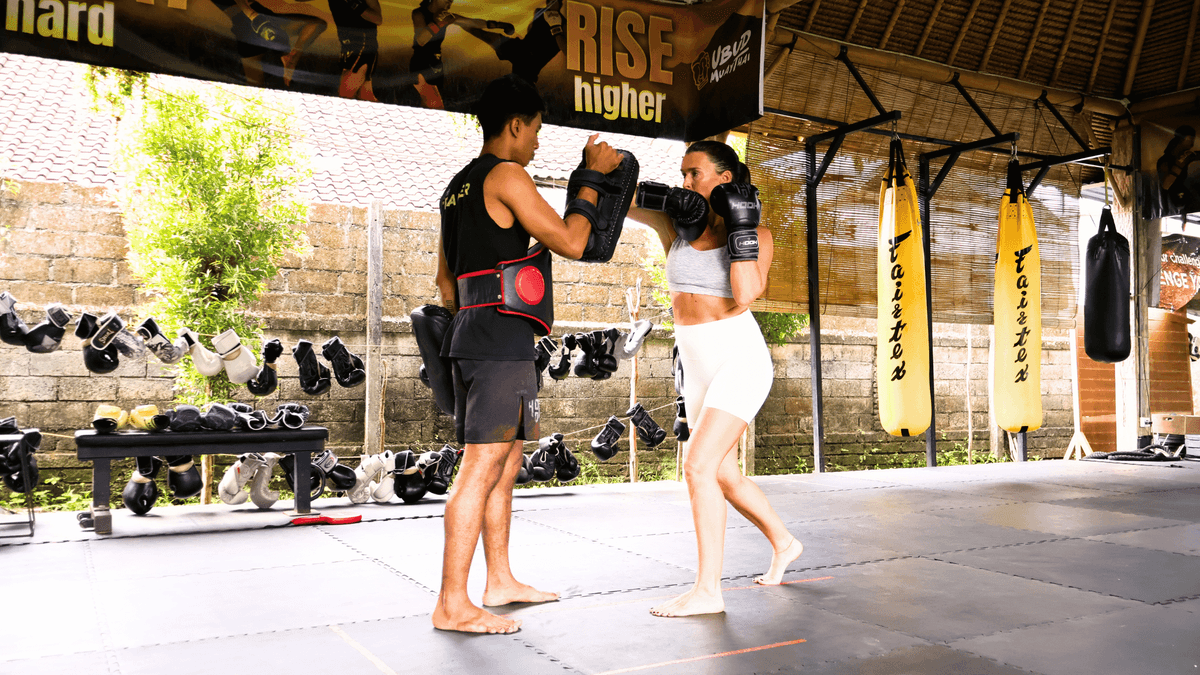
Trainers spend real time on the small details that most beginners overlook: elbow alignment, hip rotation, guard reset, and — critically — control. Being able to throw an elbow with speed and accuracy but stop it short of full contact is a skill in itself, and it's one of the first things we drill before elbows are ever used in any live training context. Control isn't a limitation on the technique. It's what makes the technique trainable at all.
This is also where our earlier piece on striking that's not permitted under Muay Thai rules is worth a read — knowing what's outside the rules of the sport gives useful context for why legal elbow technique is trained the way it is, with control and precision built in from day one, not added as an afterthought.
If you've watched elbow strikes in a fight and assumed they were reckless, spend one class working the mechanics, and you'll see how much precision actually goes into them. It's one of the more rewarding techniques to learn properly — not because it looks dangerous, but because getting it right requires real technical discipline.