

+
This guide breaks down how Muay Thai is scored, what counts as a foul, and what referees are watching for — so you can follow the action (and, if you compete, score in your own favour).
The Basics: Rounds, Format & the 10-Point Must System
Traditional stadium Muay Thai is fought over five three-minute rounds. Most modern and "entertainment" promotions use a three-round format instead.
Scoring uses the 10-point must system, borrowed from boxing: the judge awards 10 points to the fighter who wins the round and 9, 8, or 7 to the other, depending on knockdowns or standing eight-counts. An even round is scored 10–10. There's a crucial catch, though — in traditional Muay Thai, judges assess the fight more like a whole journey than a simple sum of rounds, which is why the way rounds unfold matters so much (more on that below).
How Muay Thai Is Scored: What Judges Actually Reward
Not all strikes are created equal. Judges look at the effect of your techniques, not just how many you throw.
Effective Striking and Clean Damage
This is by far the most important factor — often the lion's share of a judge's decision.
What counts is clean, accurate, powerful strikes that visibly affect your opponent. A hard body kick that lands flush scores higher than several light punches. As a rule of thumb in Muay Thai, kicks and knees carry more weight than punches, and strikes that clearly hurt or move your opponent score the highest of all.
Balance and Control After Striking
Here's something newcomers rarely realise: balance is scored. If you land a beautiful kick but stumble or get countered immediately, the value of that strike drops. Staying composed and balanced after you strike signals control — and judges reward control. This is also why sweeps and dumps (putting your opponent on the canvas) score so highly: they demonstrate total dominance of the exchange.
Knees, Clinch, and Elbows
Knees landed from a controlled clinch are among the most respected scoring techniques in the sport, because they show both control and damage. Spectacular strikes can swing rounds too — read our breakdown of the Muay Thai flying knee to see one of the highest-impact (and highest-scoring) techniques in action. Elbows, meanwhile, can change a fight instantly: an elbow that cuts or stuns heavily influences the judges.
Ring Generalship and Aggression
After effective striking, judges weigh ring generalship — who's controlling the exchanges, dictating distance, and forcing the other fighter to react. Finally, aggression counts, but only the effective kind: pushing the pace with purpose, not just swinging wildly. Importantly, you can score while moving forward, backward, or sideways — retreating and landing clean counters still score.
Traditional vs Entertainment Muay Thai Scoring
It helps to know there are two broad scoring cultures:
- Traditional / stadium Muay Thai scores the fight holistically over five rounds. The first round is a feeling-out process, the middle rounds (3 and 4) are decisive, and the fifth can be strategic — a fighter who's clearly ahead may defend safely to protect the lead. This is considered the "true" scoring system by purists.
- Entertainment Muay Thai (used by promotions like ONE Championship and the Rajadamnern World Series) scores every round independently, rewards constant action, and tends to favour aggressive, high-volume fighters. ONE Championship even judges primarily on who came closest to finishing the fight.
Knowing which ruleset you're watching explains a lot of "surprising" decisions.
Fouls: What's Illegal in Muay Thai
Muay Thai uses eight points of contact — fists, elbows, knees, and shins — but plenty is still off-limits. Common fouls include headbutting, biting, eye-gouging, strikes to the groin, attacking a downed opponent, hair-pulling, and judo- or wrestling-style throws. Breaking these rules earns warnings, point deductions, or disqualification.
Because the line between a legal and illegal technique is something every beginner should learn before sparring, we've covered it in detail in our guide to illegal moves in Muay Thai — essential reading if you're new to the sport.
What Referees Look For
While judges score, the referee controls the fight in the ring, and their job is primarily to ensure safety and fairness. A referee will:
- Enforce the rules and issue warnings or deduct points for fouls.
- Administer standing eight-counts when a fighter is hurt, and stop the bout if a fighter can't safely continue.
- Manage the clinch, breaking it up when the action stalls so the fight keeps flowing.
- Watch for fighter safety above everything — calling a doctor, pausing the action, or waving off the fight when needed.
A good referee is almost invisible when things go smoothly and decisive the moment they don't.
Why This Matters for Beginners
Even if you never plan to compete, understanding the scoring changes how you train. It teaches you to value clean technique over frantic volume, to keep your balance after every strike, and to respect the scoring power of kicks, knees, and clinch control. Those are exactly the habits that make you a better, smarter fighter on the pads and in sparring.
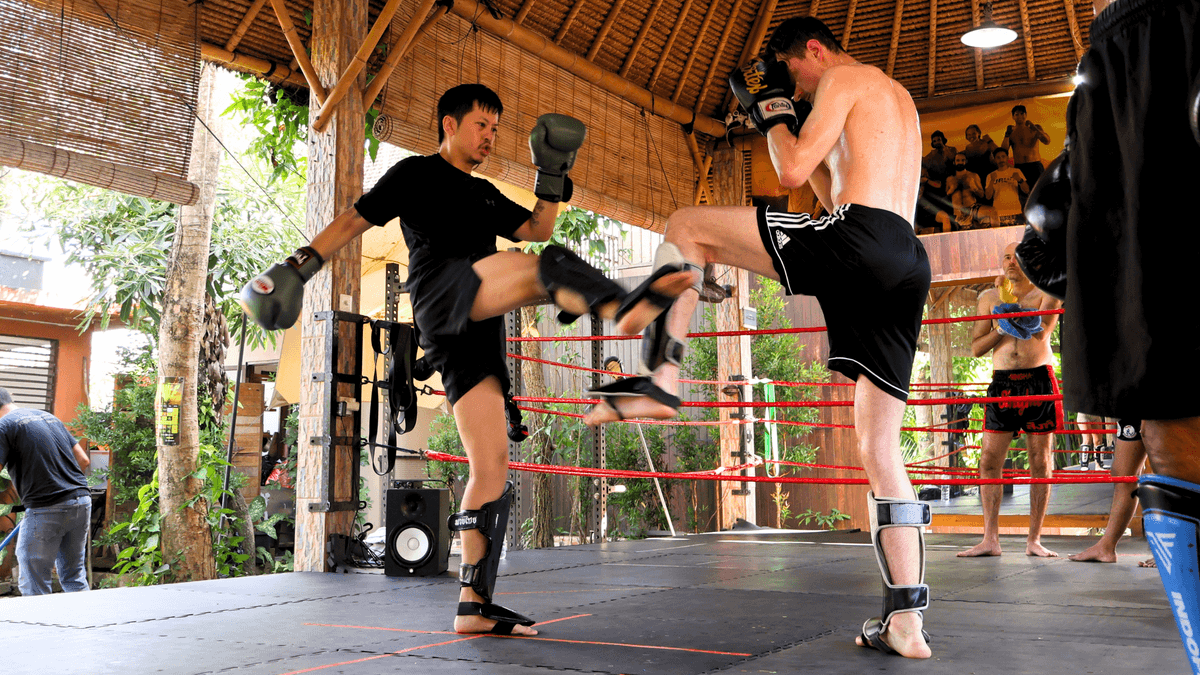
The best way to internalise all of this is to train it. Our Muay Thai classes at Ubud Muay Thai build clean, balanced, high-scoring technique from day one — whether you're aiming for the ring or just want to train like a fighter.
Watch (and Fight) Smarter
Muay Thai scoring rewards quality over quantity: clean, powerful, balanced techniques that visibly affect your opponent, backed by ring control and purposeful aggression. Once you know what judges and referees are looking for, every fight becomes easier to read — and every round of your own training becomes more intentional.
Want to put the principles into practice with coaches who live and breathe the sport? Book a class at Ubud Muay Thai and start training with the scorecard in mind.