

Ask any coach what separates a sharp boxer from a sloppy one, and most will give you the same answer: footwork. Punches get the highlights, but your feet decide whether those punches land, whether you get hit back, and whether you control the fight or chase it. For beginners, footwork is the least glamorous skill to drill — and the one that pays off the most.
This guide breaks boxing footwork basics into the pieces you can practise from day one: a solid stance, clean steps, balanced pivots, and smart ring movement. Get these right and everything else in your boxing gets easier.
Why Footwork Is the Foundation of Boxing
Footwork is what puts you in range to attack and out of range to defend. It generates power (force travels from the ground up), it keeps your balance so you can punch without falling forward, and it lets you control distance and angle. A boxer with great hands and poor feet is a sitting target; a boxer with great feet is hard to hit and always in position to fire back.
The good news for beginners: footwork is almost entirely a matter of repetition. You do not need elite athleticism to move well — you need clean habits drilled until they are automatic.
The Boxing Stance: Your Starting Point
Everything in boxing starts from your stance. Get this wrong, and your footwork, balance, and power all suffer.
Orthodox vs Southpaw
Your stance depends on your dominant hand.
Orthodox fighters (right-hand dominant) lead with the left foot and left hand forward. Southpaw fighters (left-hand dominant) do the opposite, leading with the right. As a beginner, start in the stance that matches your dominant side — your stronger hand sits in the back as your power hand.
Weight, Balance, and Hand Position
- Feet roughly shoulder-width apart, lead foot forward, rear foot at an angle, heel slightly raised.
- Weight balanced 50/50 (or very slightly back), knees soft, never locked.
- Stay on the balls of your feet so you can move in any direction instantly.
- Hands up, chin down, elbows in. Your stance is your launch pad and your shield at the same time.
A balanced stance means you can throw a punch or move out of the way without first having to "fix" your feet.
The Basic Boxing Steps: The Step-and-Drag
Beginners often try to walk around the ring like they are crossing a street. The boxing movement is different. The golden rule: never cross your feet, and never bring them together.
Instead, use the step-and-drag (also called the push step):
- Moving forward: push off the rear foot, step with the lead foot, then drag the rear foot to reset your stance.
- Moving back: push off the lead foot, step back with the rear foot, drag the lead foot back.
- Moving sideways: the foot closest to the direction you are going moves first, and the other follows.
The lead foot leads in the direction you travel, and your stance width stays the same the whole time. Small, controlled steps beat big lunges every time — they keep you balanced and ready to punch.
Pivots: Changing Angles Without Losing Balance
A pivot is how you change angle without giving up ground — and it is one of the most underused tools by beginners. The most common version is the lead-foot pivot: plant on the ball of your lead foot and rotate your rear foot around it, turning your whole body to a new angle. Suddenly, you are facing your opponent's side while they are still squared up to where you used to be.
Pivots let you slip off the centre line, create punching angles, and escape pressure. They are central to slick defensive styles — our breakdown of the Philly Shell style in boxing shows how fighters use small pivots and constant angle changes to deflect punches and counter, rather than relying on big, tiring movement.
Ring Movement & Ring Generalship
Moving well is one thing; moving with purpose is a form of generalship — controlling where the fight happens. Key ideas for beginners:
- Control the centre. The fighter in the middle of the ring dictates the pace; the one stuck on the ropes is on the defensive.
- Cut off the ring instead of chasing. Rather than following an opponent in circles, step to cut off their escape route and herd them where you want them.
- Move in and out, not just side to side. Changing distance — closing to punch, then resetting out of range — is what frustrates opponents.
Few modern boxers demonstrate footwork and angles better than Terence Crawford. Our analysis of how to fight like Terence Crawford breaks down how he uses footwork, stance switches, and angle changes to solve problems in the ring — a great study once your own basics feel solid.
Beginner Boxing Footwork Drills
You build footwork the same way you build any habit: slow, deliberate reps. Try these:
- Shadowboxing with movement: throw light punches while constantly stepping, pivoting, and resetting. Never stand still.
- The line drill: put a line of tape on the floor and practise stepping forward, back, and laterally across it without crossing your feet.
- Pivot drill: plant the lead foot and pivot 45–90 degrees, reset, repeat in both directions.
- In-and-out drill: step into punching range, throw a jab, step straight back out — over and over to build distance control.
- Mirror/partner drill: mirror a partner's movement around the floor, staying in your stance the whole time.
Five to ten focused minutes of footwork at the start of every session adds up fast.
Common Boxing Footwork Mistakes to Avoid
Most beginner footwork problems come down to the same handful of errors:
- Crossing or bringing your feet together, which destroys your balance and leaves you easy to knock over.
- Standing flat-footed, which makes you slow to move and slow to punch.
- Bouncing too much wastes energy and slows down your movement for your opponent.
- Looking down at your feet instead of keeping your eyes on your opponent.
- Overstepping with big lunges that pull you off balance.
Fixing these early saves you from drilling bad habits into your muscle memory.
Putting It All Together
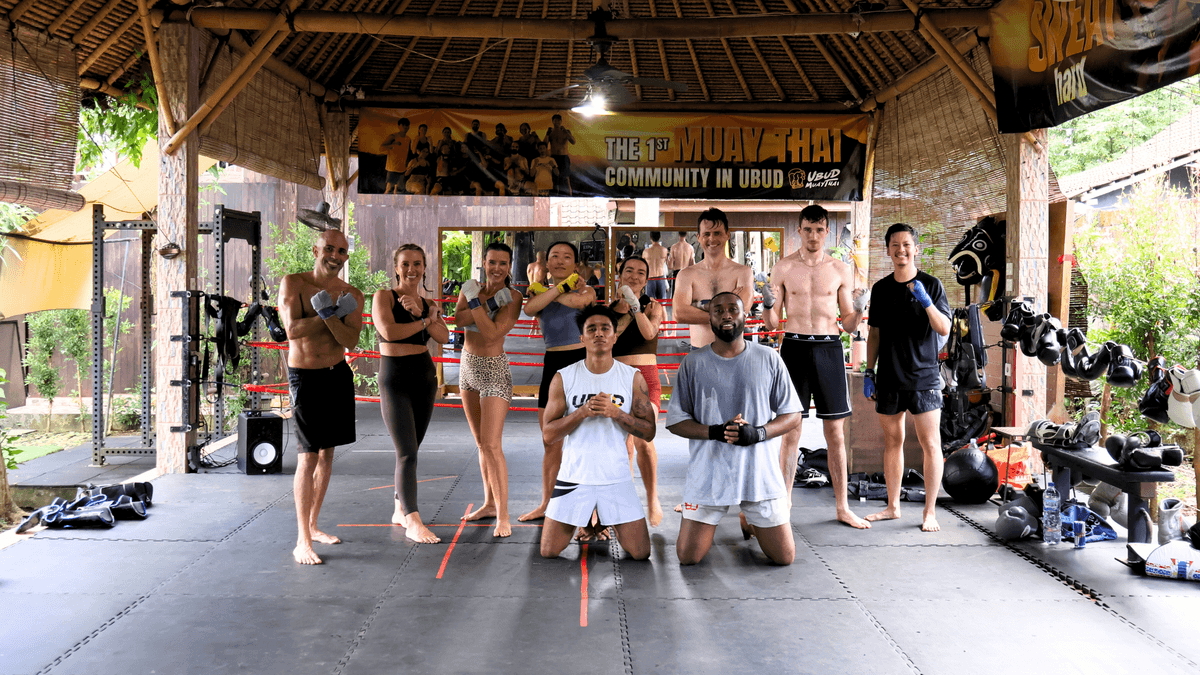
Footwork is a feeling, and the fastest way to develop it is reps under a coach who can correct your stance and steps in real time. Our boxing and Muay Thai classes at Ubud Muay Thai build footwork from the ground up for every level, so beginners can groove clean movement before adding speed and power.
Win the Fight With Your Feet
Footwork will never get the applause that a clean knockout does, but it is the quiet skill that makes everything else possible. Focus on four things every session: a balanced stance, the step-and-drag, sharp pivots, and purposeful ring movement. Drill them slowly, keep your eyes up, and let speed come with time.
Ready to put it on the floor? Book a class at Ubud Muay Thai and let our coaches build your footwork step by step.