
Walking straight at your opponent is the easiest way to get hit. The fighters who control the ring do it with angles, using smart footwork to step off the line, close distance safely, and trap opponents where they have nowhere left to go.
What Does Cutting Angles Mean in Muay Thai?
Cutting angles means moving off the straight line between you and your opponent so you can strike them while they cannot easily strike you back. Instead of stepping directly forward or backward, you step diagonally or pivot, putting yourself at an angle where their weapons are out of position, and yours are lined up.
Most beginners move in straight lines because it feels natural. The problem is that straight lines are predictable. Your opponent knows exactly where you are going, and their jab, teep, and kicks are already aimed there.
An angle changes that. Even a small step to the side forces your opponent to turn and reset before they can attack. That half second is where you land your strikes. In Muay Thai, where every exchange can include punches, kicks, knees, and elbows, controlling that half second matters more than speed or power.
Is Muay Thai Footwork Different From Boxing Footwork?
Yes. Muay Thai footwork is more upright and measured because fighters must be ready to check kicks and throw knees at any moment. Boxing footwork is lighter and bouncier, built for fast movement and head work. Muay Thai fighters move with purpose, keeping weight balanced so the lead leg can lift instantly.
That does not mean boxing footwork has nothing to teach. Stance, pivots, and basic ring movement transfer directly, and our guide to boxing footwork basics is a strong foundation before you add Muay Thai angles.
The main difference is risk. In boxing, an overextended step might cost you a punch. In Muay Thai, it can leave your lead leg exposed to a low kick or your body open to a knee. Every angle you take has to keep you balanced and ready to defend.
What Is the Z-Step in Muay Thai?
The Z-step is a footwork pattern that closes distance while staying off your opponent’s center line. You step in on a diagonal, shift laterally, then step in on a diagonal again, tracing a “Z” shape on the canvas. It lets you advance without walking straight into your opponent’s jab, teep, or kicks.
Each step should be small and controlled, with your guard up and your stance intact. The goal is not to cover a lot of ground at once but to change your position constantly so your opponent can never settle on a target.
In the video on this page, Yudhi, one of our national champion trainers, demonstrates the Z-step at full speed. Watch how his feet never cross, his hands never drop, and he finishes every step in position to strike. That is the standard to aim for.
How Do You Pivot Off the Center Line?
To pivot, keep your weight on the ball of your lead foot and swing your rear foot around in a quarter turn. Your body rotates with it, taking you off your opponent’s line of attack while keeping you square to them. A good pivot moves your head and body without moving you out of striking range.
Pivots are especially useful when an opponent charges forward. Instead of backing straight up, you step your lead foot slightly to the outside and pivot your rear leg behind you. Your opponent’s momentum carries them past you, a bit like a bull missing a matador, and you are left facing their open side.
From there, you can land a rear straight, a body kick, or a knee before they turn back around. The pivot turns their aggression into your opportunity.
How Do You Cut Off the Ring?
To cut off the ring, step laterally to mirror your opponent’s movement instead of chasing them. When they circle left, you step left to block their path. Each step reduces the space they can move into, gradually forcing them toward the ropes or a corner without you ever needing to sprint after them.
Chasing an opponent around the ring wastes energy and leaves you open to counters. Cutting off the ring is smarter. You stay calm, take small lateral steps, and let your opponent run out of room.
This is especially important against taller, longer fighters who want to keep you at the end of their reach. Our guide on how to fight a taller opponent in Muay Thai explains how angles and pressure help you close the gap that height creates.
How Do You Trap an Opponent on the Ropes?
Once your opponent is near the ropes or a corner, use kicks and lateral steps to block their exits, then close the distance with a fast entry like the Muay Thai hop. Keep your guard tight as you move in, because a trapped opponent will often throw a desperate counter.
The hop is one of the most effective tools here. Shift your weight to your rear foot, lift your lead knee, and form a shield with your elbows and knee, then skim forward across the canvas rather than jumping upward. You arrive faster than they can step away and are protected against the teep that normally keeps you out.
Body kicks are also useful for trapping. A kick to the side your opponent wants to escape toward makes them hesitate, and hesitation is all you need. Our article on how to beat bigger, stronger opponents in Muay Thai shows how positioning can neutralize a size advantage.
What Strikes Work Best After Cutting an Angle?
Straight strikes and rear-side weapons work best after cutting an angle, because your body is already lined up to drive power through them. The rear straight, rear body kick, and rear knee are the most reliable follow-ups. Looping strikes take longer to land and give your opponent time to turn back toward you.
Timing is everything. The best moment to strike is right as you finish the step or pivot, before your opponent has turned to face you. Wait too long, and the angle disappears.
Combinations also flow better from angles. A pivot followed by a rear straight and a lead hook, or a Z-step entry followed by a body kick, keeps your opponent turning and reacting instead of attacking.
How Do Boxing Footwork Drills Help Muay Thai?
Boxing footwork drills sharpen rhythm, balance, and timing, which carry straight into Muay Thai. The pendulum step teaches you to move in and out of range smoothly, while switching stances lets you open new angles your opponent does not expect. Both make your Muay Thai movement more unpredictable.
The pendulum step in boxing is a great tool for learning range control. It helps you bounce in to strike and out to safety without losing balance, a skill that translates well to Muay Thai entries.
Switching stances is another advanced option. Fighters who can work from both orthodox and southpaw create angles that single-stance fighters struggle to read. Our guide to becoming a boxing switch hitter explains how to build that skill safely.
What Are the Most Common Footwork Mistakes?
The most common footwork mistakes are crossing your feet, taking steps that are too big, dropping your hands while moving, and chasing instead of cutting off the ring. Each of these breaks your balance or leaves you exposed, turning your footwork into an opening for your opponent instead of an advantage.
Crossing your feet is the biggest risk. It narrows your base and leaves you easy to push, sweep, or knock off balance. Keep your stance width consistent no matter which direction you move.
Big steps are the second problem. They feel faster but leave you overextended. Small, frequent steps keep you balanced and ready to strike or defend at any moment.
How Should You Train Angles and Footwork?
Train angles in layers: shadowbox the Z-step and pivots slowly, add them to pad rounds, then test them in controlled drills with a partner who moves and counters. Practice cutting off the ring against a partner who circles, and finish every movement in position to strike.
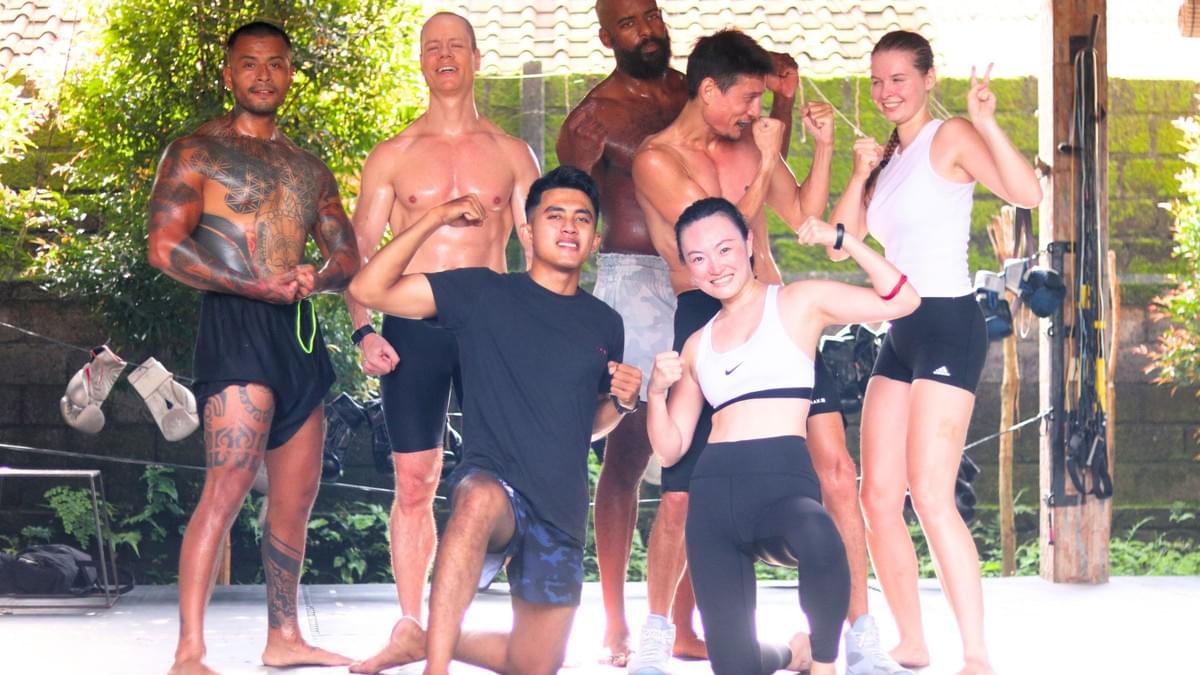
Footwork improves fastest when a trainer can watch your feet and correct small habits before they become permanent. Footwork is learned on your feet, not on a screen, so book a session and let our trainers sharpen your angles at Ubud Muay Thai in Ubud, Bali.